Astrée is a static code analyzer that proves the absence of runtime errors and invalid concurrent behavior in safety-critical software written or generated in C or C++.
Astrée primarily targets embedded applications as found in aeronautics, earth transportation, medical instrumentation, nuclear energy, and space flight. Nevertheless, it can just as well be used to analyze any structured C/C++ programs, handwritten or generated, with complex memory usages, dynamic memory allocation, and recursion.
Astrée is sound — that is, if no errors are signaled, the absence of errors has been proved.
Which runtime properties are analyzed by Astrée?
Astrée statically analyzes whether the programming language is used correctly and whether there can be any runtime errors during any execution in any environment. This covers any use of C or C++ that, according to the corresponding language standard, has undefined behavior or violates hardware-specific aspects.
Additionally, Astrée reports invalid concurrent behavior, violations of user-specified programming guidelines, and various program properties relevant for functional safety.
Astrée detects any:
- division by zero,
- out-of-bounds array indexing,
- erroneous pointer manipulation and dereferencing (NULL, uninitialized and dangling pointers),
- integer and floating-point arithmetic overflow,
- read access to uninitialized variables,
- data races (read/write or write/write concurrent accesses by two threads to the same memory location without proper mutex locking),
- inconsistent locking (lock/unlock problems),
- invalid calls to operating system services
(e.g. OSEK calls to
TerminateTaskon a task with unreleased resources), - Spectre vulnerabilities,
- other critical data and control-flow errors,
- violations of optional user-defined assertions to prove additional runtime properties (similar to assert diagnostics),
- dead code.
Astrée is also sound for floating-point computations
and handles them precisely and safely. All possible rounding errors,
and their cumulative effects, are taken into account. The same
is true for −∞, +∞ and NaN values
and their effects through arithmetic calculations and comparisons.

In 2020, the US National Institute of Standards and Technology determined that Astrée satisfies their criteria for sound static code analysis.
Now with support for C++ and mixed code bases
Since 2020, runtime error analysis can also be applied to C++ and mixed C/C++ code bases. The new analysis mode supports all modern C++ versions up to C++17 and many of the features known from the classic C code analysis.
Astrée’s C++ analysis uses the same technology as its C code analysis. It is designed to meet the characteristics of safety-critical embedded software, and is subject to the same restrictions as Astrée for C.
The high-level abstraction features and template library of C++ facilitate the design of very complex and dynamic software. Extensive use of these features may violate the established principles of safety-critical embedded software development and lead to unsatisfactory analysis times and results. The Astrée manual gives recommendations on the use of C++ features to ensure that the code can be well analyzed. For less constrained (less critical) C++ code, we recommend using the standalone RuleChecker.
MISRA and more

The seamlessly integrated RuleChecker lets you check your code for compliance with various coding standards, including MISRA, CWE, ISO/IEC, SEI CERT, and AUTOSAR. You can easily toggle individual rules and even specific aspects of certain rules. The tool can also check for various code metrics such as comment density or cyclomatic complexity. Custom extensions for your own in-house coding guidelines are available on request.
RuleChecker can be envoked separately, to allow for even faster checks of your code, or in conjunction with the sound semantic analyses offered by Astrée, to additionally guarantee zero false negatives and minimize false positives on semantical rules. No competing standalone MISRA checker can offer this, and no testing environment can match the full data and path coverage provided by the static analysis.
Who uses Astrée?

Since 2003, Airbus France has been using Astrée in the development of safety-critical software for various aircraft series, including the A380.

In 2018, Bosch Automotive Steering replaced their legacy tools with Astrée and RuleChecker, resulting in significant savings thanks to faster analyses, higher accuracy, and optimized licensing and support costs.

Framatome employs Astrée for verification of their safety-critical TELEPERM XS platform that is used for engineering, testing, commissioning, operating and troubleshooting nuclear reactors.

The global automotive supplier Helbako in Germany is using Astrée to guarantee that no runtime errors can occur in their electronic control software and to demonstrate MISRA compliance of the code.

In 2008, Astrée proved the absence of any runtime errors in a C version of the automatic docking software of the Jules Verne Automated Transfer Vehicle, enabling ESA to transport payloads to the International Space Station.

A world leader in motors and ventilators for air-conditioning and refrigeration systems, ebm-papst is using Astrée for fully automatic continuous verification of safety-critical interrupt-driven control software for commutating high-efficiency EC motors for ventilator systems.

MTU Friedrichshafen uses Astrée to demonstrate the correctness of control software for emergency power generators in power plants. Together with its qualification package, Astrée is part of the IEC 60880 certification process.
Tailor it to your own requirements
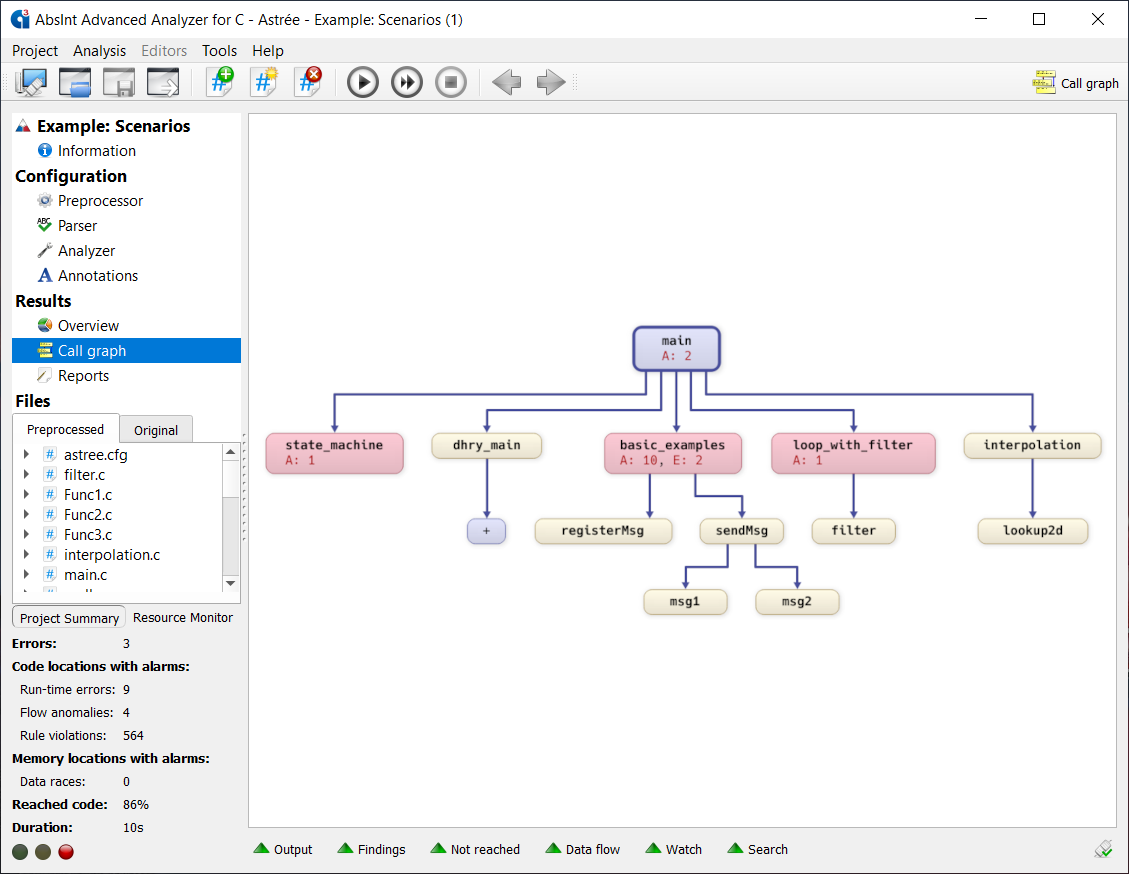
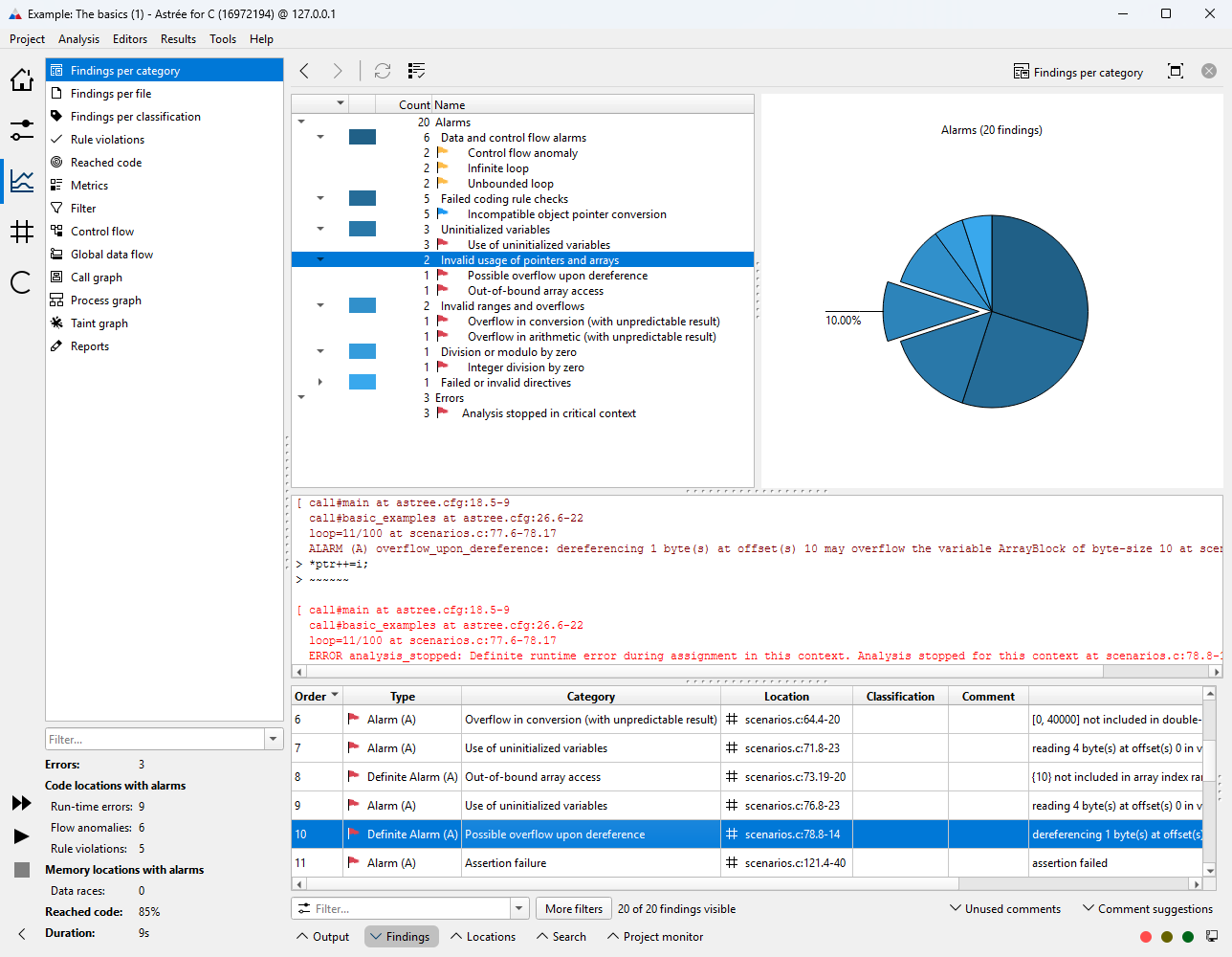
Astrée offers powerful annotation mechanisms for supplying external knowledge and fine-tuning the analysis precision for individual loops or data structures. Detailed messages and an intuitive GUI guide you to the exact cause of each potential runtime error. Actual errors can then be fixed, and in case of a false alarm the analyzer can be tuned to avoid it. This allows for analyses with very few or even zero false alarms.



The analyzer can also run in batch mode for easy integration into established tool-chains.
Plugins for TargetLink, Jenkins, and Eclipse are available and actively supported.
Qualification support
Your usage of Astrée can be qualified according to DO-178B/C, ISO 26262, IEC 61508, EN-50128, the FDA Principles of Software Validation, and other safety standards. We offer special Qualification Support Kits that simplify and automate the qualification process.
Ten years ahead of competition
Astrée is…
Sound
Most static analyzers do not consider all possible runtime errors. Others specifically focus on the most probable ones.
As a result, almost all competing tools can only be used for static testing (i.e. finding some frequently occurring bugs), but never for verification (i.e. proving the absence of any runtime errors).
In contrast, Astrée is sound. It always exhaustively considers all possible runtime errors. It will never omit pointing out a potential runtime error. This is crucial for verification of safety-critical software. At the same time, Astrée is capable of producing exactly zero false alarms.
In 2020, the US National Institute of Standards and Technology determined Astrée to be one out of only two tools in total that satisfy their criteria for sound static code analysis.
Automatic
Certain types of static analyzers, e.g. those relying on theorem provers, require programs to be annotated with lots of inductive invariants.
Astrée usually requires very few annotations. It can even run completely automatically on certain types of programs, without relying on any help from the user.
Many analyzers cannot be scripted at all. Others can, but won’t let you access their analysis results outside of their proprietary viewer. This actively prevents you from automating the analysis, e.g. as part of your nightly build process.
In contrast, Astrée offers you complete access to the analysis engine in batch mode, and lets you freely export the analysis results and further process them in any way you choose, no strings attached.
Fast
Many static analyzers have high computational costs (typically, several hours of computation per 10,000 lines of code); others terminate out of memory, or may not terminate at all.
In contrast, Astrée is efficient and easily scales up to real-world programs in industrial practice.
As an example, in order to analyze actual flight-control software with 132,000 lines of C code, even on a slow 2.8GHz PC Astrée takes a mere 80 minutes. Faster machines will get you faster results. Multicore parallel or distributed computation is supported.
Domain-aware
General-purpose static analyzers aim at analyzing any application written in a given programming language. They can rely on language related properties to find potential runtime errors. Specialized static analyzers put additional restrictions on the applications so as to be able to take specific program structures into account.
In contrast, Astrée is domain-aware. It thus knows facts about application domains that are indispensable to make sophisticated proofs. For example, for control/command programs, Astrée takes the logic and functional properties of control/command theory into account.
Parametric
In static program analysis, there is always a trade-off between analysis precision and analysis cost. Analyzers that are precise are usually also very slow, while fast analyzers usually lack precision.
In contrast, Astrée is parametric, allowing you to freely trade speed for precision and vice versa. The level of abstraction used for analysis can be easily tailored to your very own requirements.
Modular
Astrée consists of several modules — so-called abstract domains. These modules can be assembled and parameterized to build application-specific analyzers that are fully adapted to a particular application domain or specific end-user requirements.
In case of false alarms, Astrée can be easily extended by introducing additional modules that enhance the precision of the analysis.
Precise
General-purpose static analyzers usually suffer from low precision in terms of false alarms, i.e. spurious warnings about errors that can actually never occur at runtime. The ratio of false alarms to the number of basic C operations typically ranges between 10% and 20%.
Specialized analyzers achieve a better precision of 10% or less. However, even a very high selectivity rate of only 1 false alarm for every 100 operations is usually unacceptable for large real-world applications. For example, on a program with 100,000 operations, a selectivity rate of only 1% yields 1000 false alarms.
In contrast, thanks to its modularity and domain-awareness, Astrée can be made exceptionally precise, often to the point of producing exactly zero false alarms. This has been repeatedly proven in industrial practice, e.g. when analyzing primary flight-control software for Airbus.
Up-to-date
Astrée builds upon decades of research in static program analysis, and also makes sure to incorporate the latest ongoing research, always staying well ahead of any competition.
Major new releases are published twice a year, intermediate releases more often still. If you have a feature request, let us know at support@absint.com.

Free trial
Start your free trial today, complete with online training and technical support.

