aiT WCET Analyzers statically compute tight bounds for the worst-case execution time (WCET) of tasks in real-time systems. They directly analyze binary executables and take the intrinsic cache and pipeline behavior into account.


The challenge
In real-time systems, timely task completion is of the essence. Each real-time task has to be completed within a specified time frame in order to ensure that the system works correctly. In other words, it is essential that the WCET of each task is known.
However, computing the WCET is a challenge:
“Testing, in general, cannot show the absence of errors.”
- Testing by repeatedly measuring the execution time of a task is tedious and typically not safe. It is often impossible to prove that the conditions determining maximum execution time have been taken into account.
- Modern processor components such as caches and pipelines complicate the task of determining the WCET considerably, since the execution time of a single instruction may depend on the execution history.
- Analysis methods that do not consider cache and pipeline behavior typically overestimate the WCET by orders of magnitude, leading to a substantial waste of hardware resources.
“Testing by itself is not sufficient.”
The solution
aiT WCET Analyzers provide the solution to these problems: they statically analyze a task’s intrinsic cache and pipeline behavior based on formal cache and pipeline models. This enables correct and tight upper bounds to be computed for the worst-case execution time.
The analyzers are based on the technique of abstract interpretation. A graphical user interface supports the visualization of the worst-case program path and the interactive inspection of all pipeline and cache states at arbitrary program points.
Your benefits
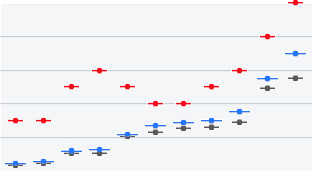
— Volvo’s traditional method for estimating WCET
— aiT analysis results
— measured WCET
- aiT-computed bounds are extremely tight and thus reflect the actual performance of your system. Ensuring deadline adherence is not done at the expense of hardware resources.
- aiT-computed bounds are valid for all inputs and each execution of a task. Extensive timing testing is a thing of the past.
- aiT directly analyzes binary executables. It is widely independent of the compiler and source code language used. This means no modification of your toolchain or the system’s operational behavior and performance is required.
Who uses aiT?
aiT was originally designed in close collaboration with Airbus France. For twenty years now, it’s been used at the Toulouse plant for validating the timing behavior of critical avionics software, including the flight control software of the A380.
Daimler uses aiT in many automotive software projects, including the powertrain control system of the new Actros truck.
Vestas uses aiT for static analysis of their wind turbine control software.
OHB uses aiT in the development of software for geostationary communication satellites and satellite navigation.
MTU Friedrichshafen uses aiT to demonstrate the correctness of control software for emergency power generators in nuclear power plants.
The Technical University of Munich uses aiT in the development, testing and optimization of flight control and navigation algorithms.
NASA used aiT as an industry-standard static analysis tool for demonstrating the absence of timing-related software defects in the 2010 Toyota Unintended Acceleration Investigation.
Supported targets
aiT is available for a wide and ever-growing array of target processors and compilers.
Seamless integration into your toolchain
aiT supports tight integration with many state-of-the-art development tools, including:
- SCADE Suite, the market-leading embedded-software development environment from ANSYS




- TargetLink, the production-code generation tool from dSPACE
- SymTA/S scheduling analysis tools from Symtavision/Luxoft
- Jenkins, the leading open-source automation server
- ASCET modeling tools from ETAS
- WCC, the first WCET-aware C compiler from TU Dortmund
- RT-Druid, the Eclipse-based development environment from Evidence
aiT can also be combined with other analysis tools from AbsInt (e.g. StackAnalyzer for stack usage analysis) in the same user interface.
“aiT is very easy and straightforward to use”
“the best capabilities to resolve dynamic calls automatically”
“the most feature-complete tool”
“a clear winner in terms of additional functionality”
Comparison of WCET tools by University of Stuttgart (PDF)
Qualification support
Your usage of aiT can be qualified according to ISO 26262, DO-178B/C, and other safety standards. We offer special Qualification Support Kits that simplify and automate the qualification process. These Kits are especially popular with our customers in the avionics and automotive industries.
aiT is also available as an integral part of the SCADE development environment, which is DO-178B and DO-178C qualified up to level A for Military and Aerospace Industries, IEC 61508 certified at SIL 3 by TÜV for Heavy Equipment and Energy, and EN 50128 certified at SIL 4 by TÜV for Rail Transportation. Within the SCADE Suite, you’ll find aiT under the name “Timing Optimizer”.

Free 30-day trial
Request your free trial package today, complete with free training and support.
